
The Gentle Marathon

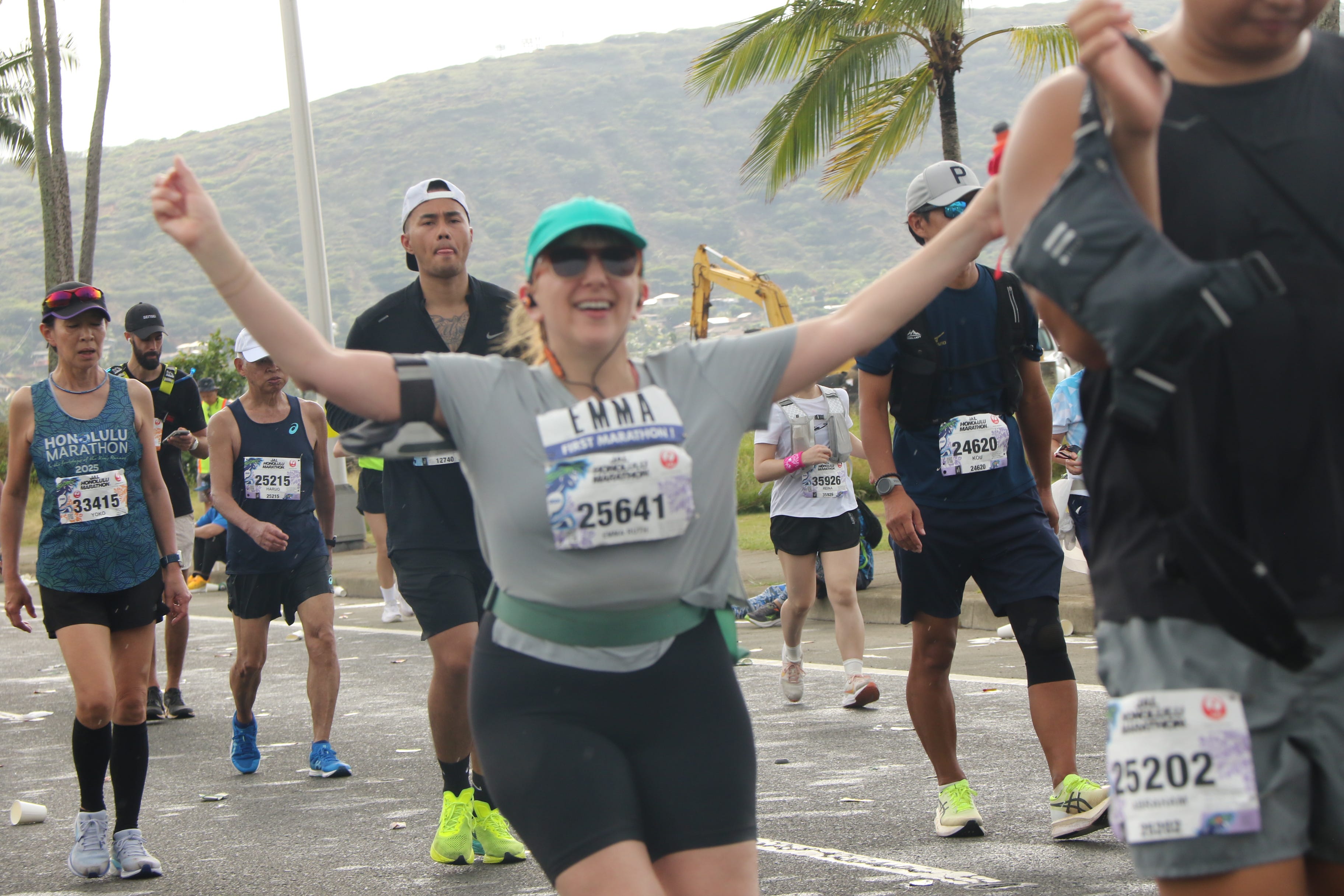
I set my sights on the Honolulu Marathon because the finish line stays open until the last runner crosses. That appealed to me for both emotional and practical reasons. The “aloha spirit” firstly drew me in, but from a safety standpoint, you want your first marathon to be one where the aid stations stay out to support you. In this race, I was at times running with my hand full of ice chips. Support in the heat was a top priority.
I learned about the time-limitless Honolulu Marathon from my sister-in-law, an avid hiker who is plugged into communities that know of such things. She told me about it in November of 2024, and the idea immediately seized me.
It reminded me of Elizabeth Gilbert’s book about writing, Big Magic, in which she describes the concept of “the grand gesture.” The example she gives in the book is of JK Rowling who, facing procrastination and resistance in writing the final Harry Potter book in the series, checks herself into a lavish hotel for a long stay until she can complete the manuscript without distraction.
The logic behind “the grand gesture” is that you support a brave and bold action with something outrageous. You bet on yourself. And back yourself into a corner to deliver on your promise to yourself. I brought the idea of the Honolulu Marathon to my husband, Luke, and instead of saying something reasonable to me like, Can’t you find a more local marathon? or …Do you even run? He replied contemplatively with, “I’ve never been to Hawaii.”
I registered for the December 14 marathon in July of 2025. That moment was exhilarating and when we booked the Airbnbs in August for our December trip, the whole thing still seemed surreal. The trip planning unfolded like that, but the training for the marathon itself ran a longer and more incremental course.
From January 2025 to June 2025 I had a regular dog walking route with Brooklyn Bark.
I tried to make sure I walked to and from my first appointments, instead of taking the subway, to add extra mileage to my days. I averaged 30 to 50 miles per week of walking, mostly always in the 40 to 50 miles per week range.
In May, while dogsitting a Frenchie named Oscar in a palatial apartment overlooking the water in Williamsburg, I read Haruki Murakami’s book, What I Talk About When I Talk About Running. Murikami cited jogging 30 to 50 miles per week as his own marathon training plan. His book also opens with him running in Hawaii. Two fortuitous details that made me think I was accidentally doing things right. (I was walking those miles and he was jogging them, but still, I was pleased by the synchronicity.) Reading Murikami with puppy Oscar rising and falling on my chest made for an auspicious beginning.
I didn’t start jogging until July. I pulled the tissue paper off my brand new Nike Trail sneakers (with a wide toe box, which is a must for me) and began to jog.
I knew that summer would be a key time to train because the Honolulu heat and humidity was its own significant facet of this marathon. Internet chatter was emphatic on this point. My first jog in those shoes, and indeed my first jog in many years in any shoes, was on a family trip with my nieces and nephew in Rhode Island by the water. I jogged for 30 minutes. From there, I built up. I felt solid starting because I was building on all the walking and the gear I’d been carrying and the flights of stairs up and down in the various brownstones where I would dog walk.
As I added longer runs and the marathon training became more tangible, I’d find myself on Reddit late at night seeing what other runners had to say.
With each question I Googled, a curious pattern began to emerge for me from the responses. The newbie runners on Reddit would reply with absolutes: You must do this when you train. You must use this gear. You must eat this way. And then every sixth response or so, without fail, a Redditor would say something like this: “Hey there. 20 time marathoner here. Yeah, I just eat normally, so do whatever works for you. Hope this helps!”
Through my nightly perusal of message boards, a clear theme emerged.
The people who knew the most had made their own rules and eschewed the dogma that seemed now, as I saw it, to be the hallmark of the naive beginner. It was then that my own running approach began to crystallize.
What might this process look like if I followed my intuition?
All the most experienced runners seemed to be listening to their bodies while the newbies shouted rules at one another on Reddit.
Of course it was like this. All things are like this. And then I thought about my Torah portion, which I chanted for the Beth Israel congregation on September 19th, 1998. Nitzavim in Deuteronomy:
Surely, this Instruction which I enjoin upon you this day is not too baffling for you, nor is it beyond reach.
It is not in the heavens, that you should say, “Who among us can go up to the heavens and get it for us and impart it to us, that we may observe it?”
Neither is it beyond the sea, that you should say, “Who among us can cross to the other side of the sea and get it for us and impart it to us, that we may observe it?”
No, the thing is very close to you, in your mouth and in your heart, to observe it.
This theme from Deuteronomy, which floated back as I sifted through the message boards of Reddit, now began to appear all over my running journey.
People would ask me, do you have a coach? A book, an app? Did ChatGPT design your training plan? How will you avoid injury? Do you need to be running right now instead of talking to me? Are you on track with your training plan?
What I observed throughout the months that followed, when I shifted from walking to running, which was the July to late November plan, was the excitement and the nerves of others. “The marathon” as a concept brought out such a range of expectations and projections from friends and family. It was thrilling to be actively engaged in something with so much buy-in from others, but I saw over and over in the reactions of my loved ones, this strange belief that someone outside me would have the answers, or that I must purchase the fanciest gear, or that I was undertaking an exotic endeavor and needed a guide to save me.
My belief system began to form in opposition to this. My feelings about running took shape thusly:
Women have been running for millennia. Covering long distances. For hunting. For water. For berries. Don’t forget that you already know how to do this! Unlike cheetahs, we can wear fanny packs! This is why we can go very far: Because we carry water.
So running had, in my perception, quickly undergone the same evolution that the Torah had.
A little background on my Bat Mitzvah Torah portion: Initially the Torah was the province of the Kohanim, the elite sages and scholars born into the priestly class. After the destruction of the second temple, it was no longer practical to have one specific nepo baby priest doing all your goat sacrifices and so, the study of the Torah started to become democratized. Rabbis sprung up, not born into the fold but studying their way into it, and civilians began to learn and study Torah, too. Obviously I only know this because I landed an absolutely plum Torah portion/Bat Mitzvah date. This historical tidbit is salient because it dovetails nicely with this Deuteronomy banger about how the commandments are now in your heart and mouth.
It was, and still is(!), radical to say — you (yes YOU) know what is needed to live and thrive. You’ve got this, random woman in the tribe and/or stranger in our midst.
This democratization of study that placed the Torah in the hands of civilians and their teachers (rabbis) was critical to the survival of Judaism. It’s also kind of like Reddit: Regular people fighting with one another and every 6th comment or so is from someone who actually knows what they’re talking about.
The Torah became available to the average man for study in the yeshiva and that gave way, eventually, to the beautiful film, Yentl.
I saw that running was mine. And the key to training soundly and remaining uninjured was to listen to my body, my own personal in-demand coach/consultant.
I didn’t need the priestly class to teach me how to use my own legs. I would listen to my own wisdom, the local running rabbi in my heart.
I slept a lot. I walked more days than I ran.
I ate protein, and I hydrated and used electrolytes. I developed a plan to take electrolytes before I needed them and to generally anticipate my needs at every turn. Conventional wisdom (from internet chatter) was to train for a marathon with your longest run being 18 miles as opposed to the 26.2 of the marathon itself. I knew I’d be ignoring that.
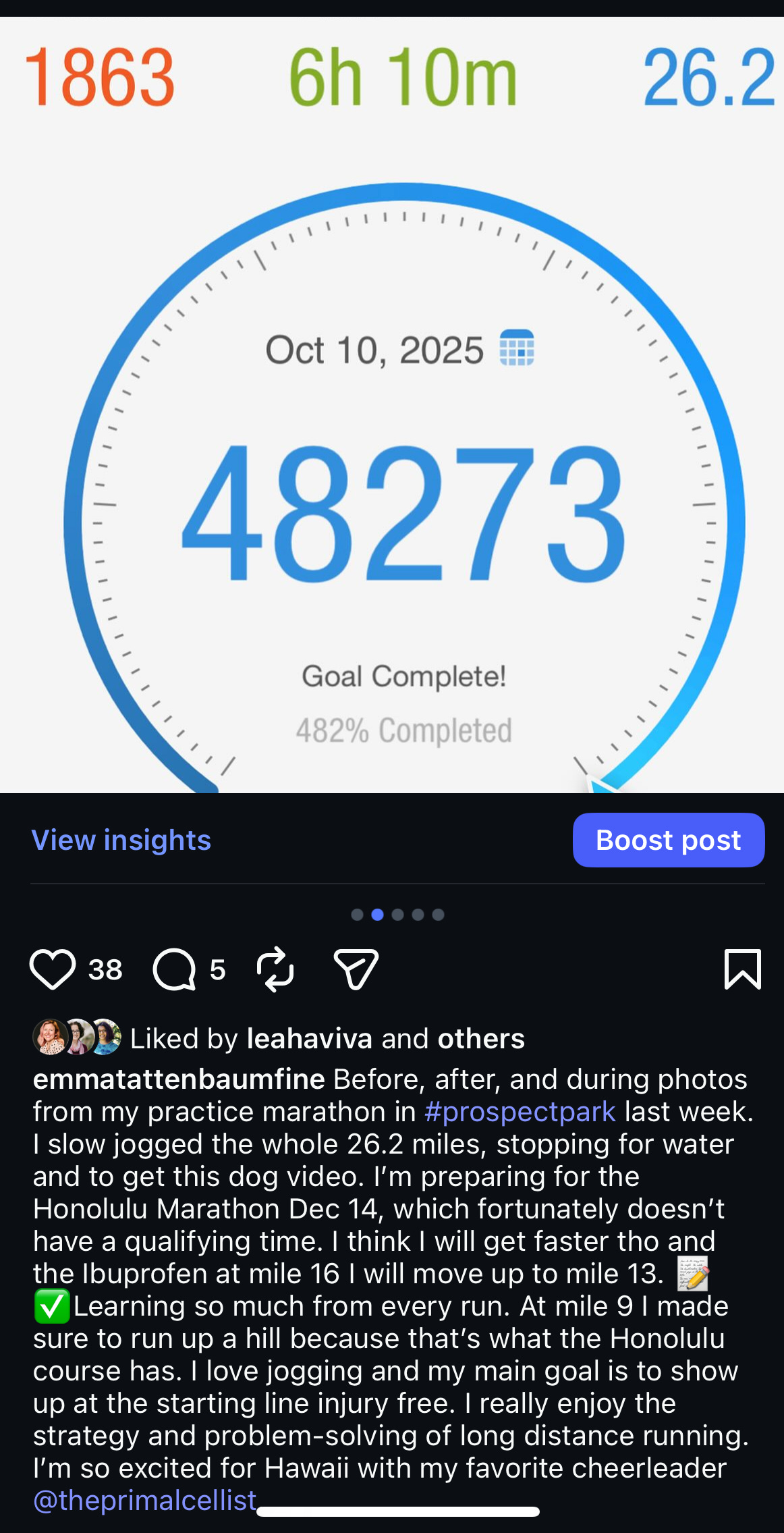
I had to practice the real 26.2 as a proper dress rehearsal. This intuitively-designed plan proved wise. My October practice marathon built the foundation for everything I did in December. I learned more in the last eight miles than all the rest.
During my training runs, I coined a term for myself: “the gentle marathon.”
When I experienced fatigue, boredom, or tension, I asked myself, how can I make this gentler? And with that, I’d send a breath of fresh air to the top of my right foot, and within moments, the pain there would dissipate and the stuck energy would move.
Often I’d go to sleep with some soreness or what felt like a budding injury, only to wake up with it healed. That nightly renewal, I believe, would not have been possible if I still drank alcohol or if my sleep was poor or interrupted. My body’s ability to renew itself was the thing that most surprised me during this process. I’ve read that menopause destroys that, but I saw plenty of much older women out running with me, so perhaps they’re ignoring Reddit, too.
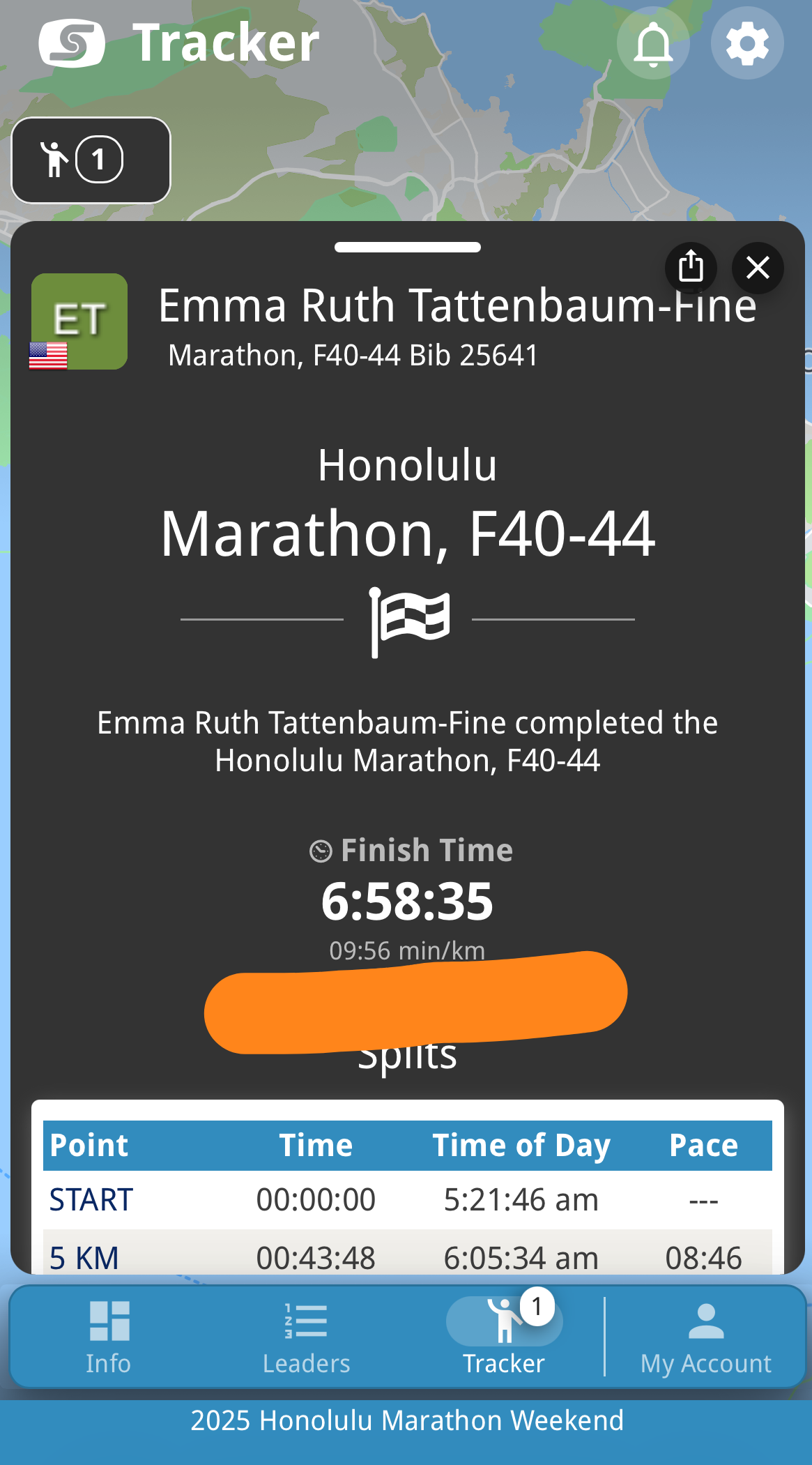
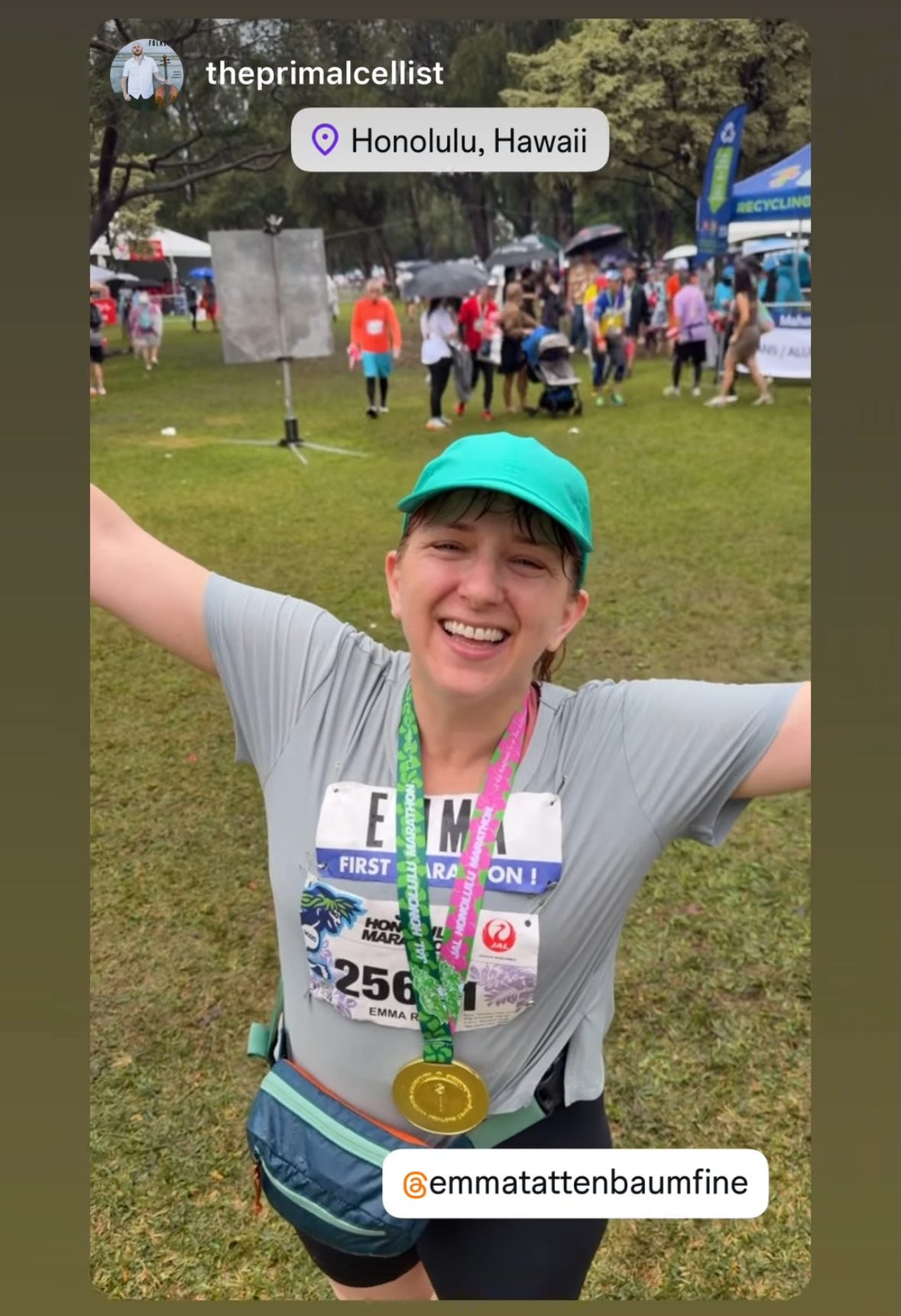
My practice marathon (my 6th one since 2020, but my first time jogging it) was slow and my Honolulu time (7th marathon distance, 2nd time jogging all the way) was slower, with the torrential downpours, direct sun, and winding around crowds of walkers, but nonetheless, I exceeded my main goal, which was to get to the start line with no training-related injuries (nor a cold) on race day.
My plan initially was to walk the Honolulu Marathon. I had walked 5 marathons previously in Prospect Park and was getting to the point where it seemed important to level up. I wanted to take this sort of strange, odd, useless, but somehow sacred desire to walk long distances and celebrate it in some public way?
One day I was training one of the new Brooklyn Bark dog walkers (training entails showing a new hire the ins and outs of the app we use and the company’s quirky practices and general dog and human safety tips) and as I was training this employee, in the hours we spent walking together, I shared news of walking the upcoming marathon. She said, as we power walked, “Well, you walk really fast so I bet you’ll have a fast time. You’re practically jogging when you walk.”
So that evening, this was spring 2025, was when I realized I might as well just… jog the marathon.
The other part of my Torah portion that has floated back to me in this surprising instance of resonance is the concept of Nitzavim, which literally means “standing there.”
I am making this covenant, with its oath, not only with you who are standing here with us today in the presence of the Lord our God, but also with those who are not here with us today. (Deuteronomy 29:13-14)
When my ancestors received the commandments, I was there too, included before Moses, as I must have written in my Bat Mitzvah speech because it’s customary to highlight that critical bit when discussing this passage. And this, the presence of and union with ancestors, is precisely the haunting awareness that running has made alive in me. As I run, I’m connected to all the movers throughout time. This is what humans have done, traversed long distances. My body is also their body, and as I was “standing there,” my ancestors too are “running here” with me.
This idea of melded timelines, of the Jewish people of every future generation standing there in one place throughout all time, always appealed to me. It’s very sci-fi. It’s also a lot how you feel when you’re overheated: That time is a construct and you may be in a few realities simultaneously.
As I ran the Honolulu Marathon, a brand new mantra came to me, which I must have said a thousand times that day, especially on the steep hills at miles 22 and 23:
No past. No future.
Gentle gentle.
Head up. Chest up.
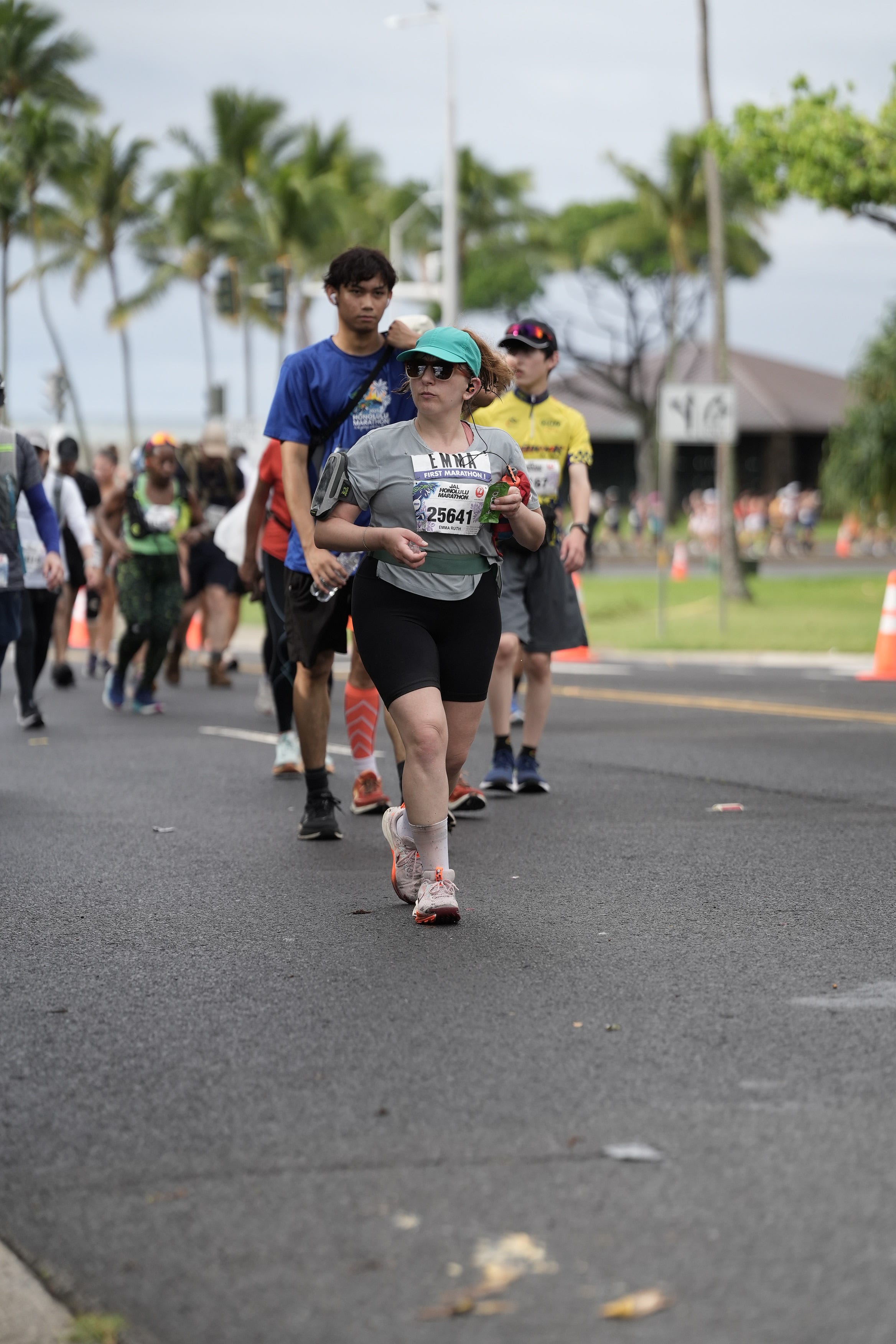
I found that thoughts of anything but the present would hemorrhage precious energy. I sought to make myself gentle. And to keep my head and chest up, keeping a soft smile when I could, to telegraph to my body, a white lie that I could make true, that all was well and peaceful.
I’d be remiss as an atheist if I didn’t mention that this same section of the Torah also has quotes about not sleeping with beasts nor with your mother-in-law. Generally great advice(!), but considerably less relevant to my marathon journey.
But it’s no coincidence that learning to jog a marathon brought up memories for me of a time of study, transformation, critical thinking, self-reflection and standing before a congregation to share my knowledge. I found the marathon training and running process to be rich with self-expression, a chance to lead by example, and an exercise in creative problem-solving. I found ways to tune in to my own self-knowledge. I’ll never forget the softening into difficulty and asking: how can I make this marathon more gentle? And at every turn gentleness unlocked new available energy for me to use.
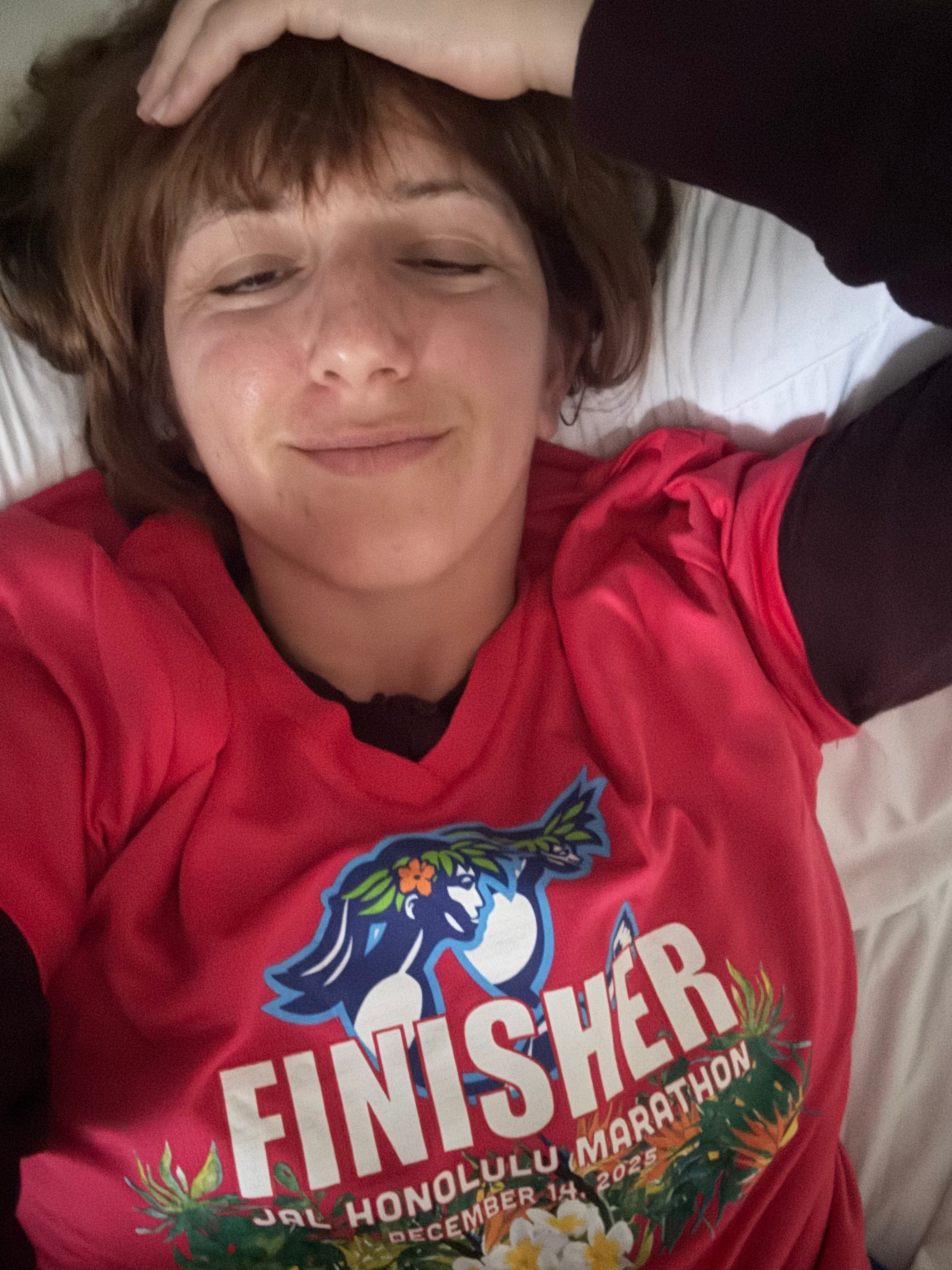
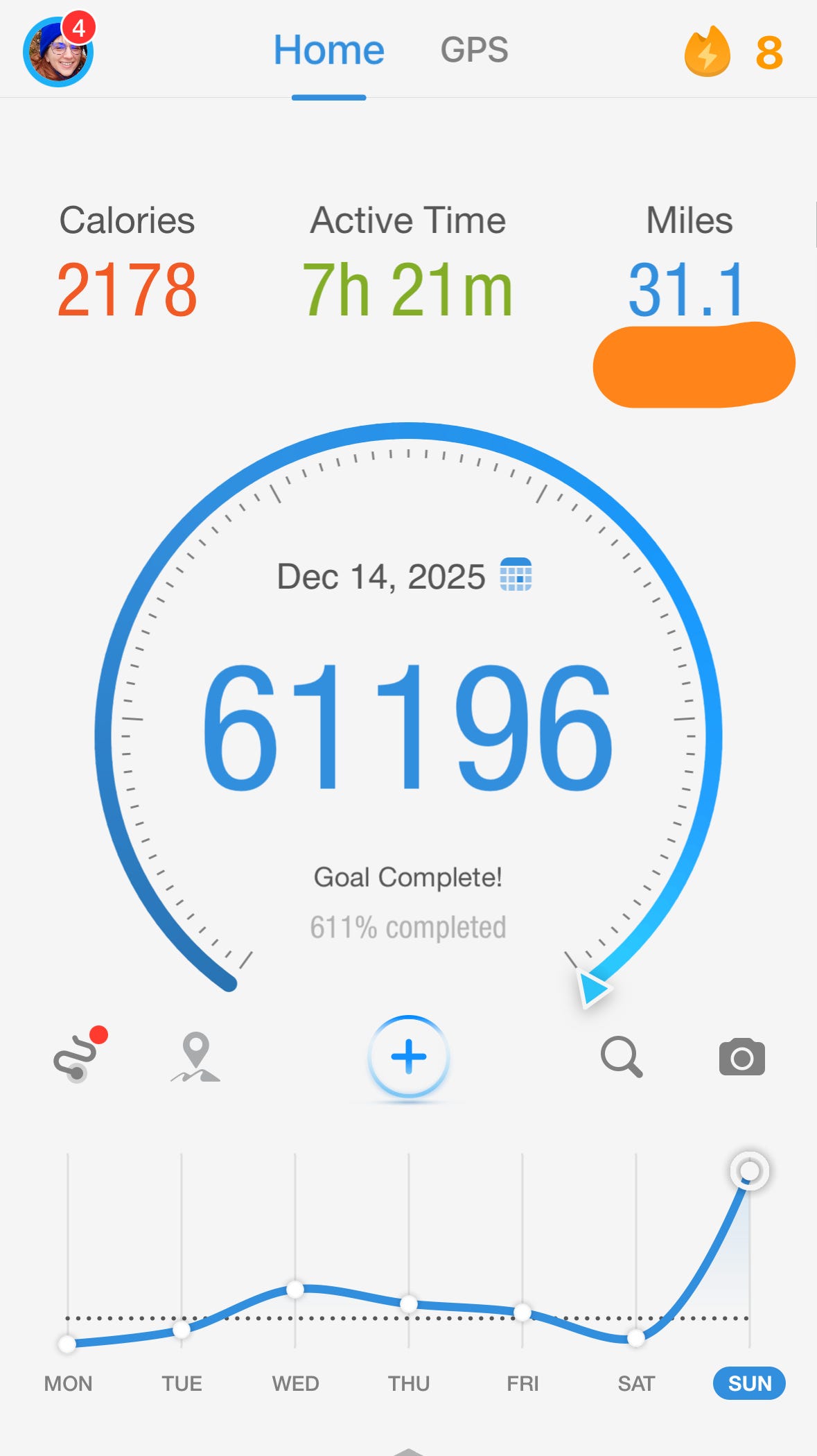
Special thanks to Luke!!!!! For everything.
P.S. If you, dear reader, are a Torah scholar and have corrections or feedback to offer, I invite you to comment or message me and I may edit accordingly!
This is so beautiful and moving.
Please send to others so that 2026 begins with Emma’s insights about life.
What a beautiful piece. You are a truly unique creation. Also, you got a lot of mileage out of that bat mitzvah!